West of Chengdu the landscape changes completely. Within a few hours the Sichuan basin gives way to high open grassland, with monasteries, grazing yaks, strings of prayer flags and snow peaks that stay white all year.
This is one of the most beautiful drives in China, and much of the pleasure is in the journey itself rather than any single stop. It is also high country, so there is a short note at the end on what that means in practice.
Yading Nature Reserve
Yading is the reason most people make this trip. Three snow peaks stand unusually close together at its centre, and each is held sacred in Tibetan Buddhism. Xiannairi is the highest, Yangmaiyong the sharpest and most photographed, and Xianuoduoji the third.
You explore on foot, with shuttle buses and electric buggies covering the longer stretches, and you can climb as much or as little as you like. Chonggu Monastery sits at the base of the first peak, small and weathered rather than grand, and makes a good first stop while you find your legs.
Pearl Lake is the easy walk and the one most people love, a short climb through forest to a small green lake with the mountain standing directly behind it. For many visitors this is the photograph of the trip.
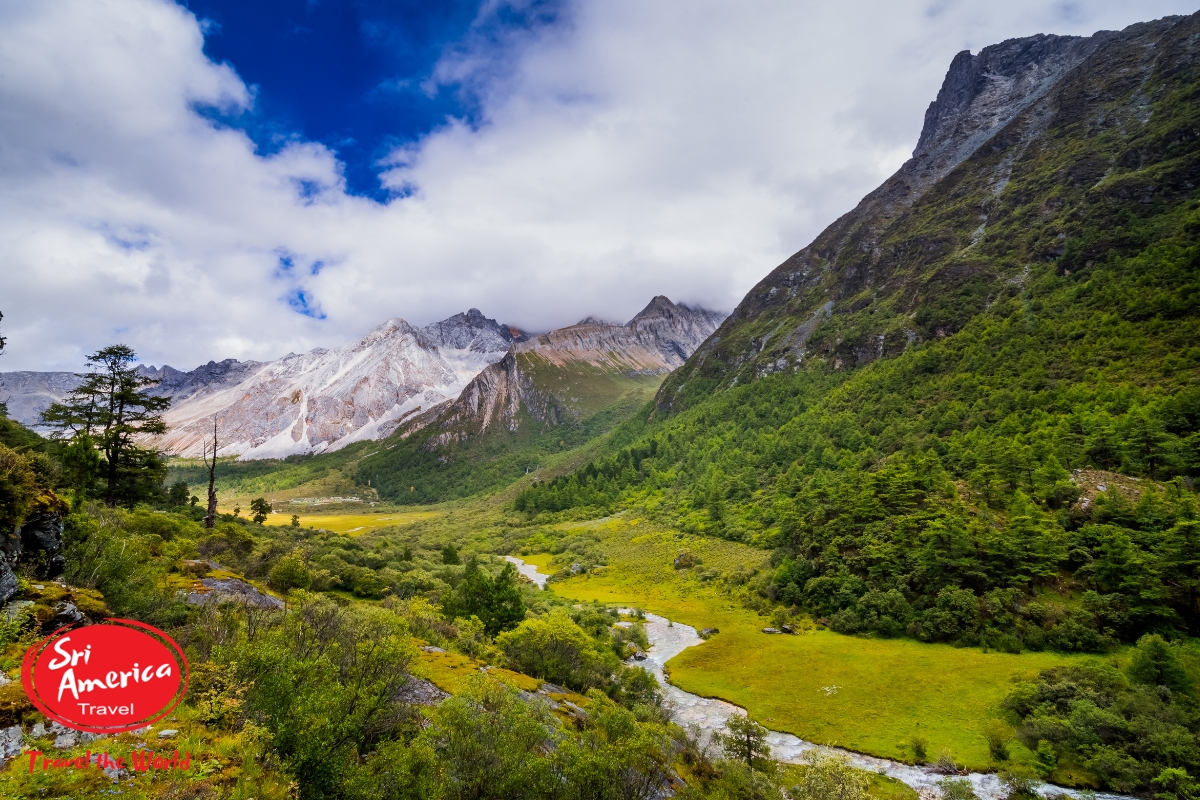
Higher up, Luorong Pasture is a broad meadow with a stream running through it and all three peaks visible at once. It is a lovely place simply to sit for a while. From here a trail climbs on foot to Milk Lake and Five Colour Lake, a proper walk at this altitude, so allow plenty of time and go at your own pace. The colour of those upper lakes, a deep and almost artificial turquoise, rewards the effort. Plenty of people stop at the pasture instead and enjoy the day just as much.
Yading is often called the last Shangri-La, a name that goes back to a botanist who reached these peaks in the 1920s and wrote about them for National Geographic. Standing at Luorong with all three mountains in view, it is not hard to see why the name stuck.
Mount Siguniang
Closer to Chengdu, Mount Siguniang rises in four peaks in a line, which is how it earned the name Four Sisters. The main summit is the easternmost peak on earth above 6,000 metres, and the whole massif sits within a UNESCO World Heritage area protecting wild giant panda habitat.
Double Bridge Valley is how you see it. A shuttle bus runs the length of the valley with stops along the way, so you ride between viewpoints and walk the short boardwalk sections that appeal to you. Along the route are alpine meadows, small lakes, a striking coloured mountain face and a run of rock spires with names like Sun and Moon Mirror Peak. Autumn is spectacular here, when the larch forest turns gold against the snow. Give it most of a day.
Tagong and Xinduqiao
Tagong is where the landscape becomes unmistakably Tibetan. Wide open pasture, grazing yaks, prayer flags and a sacred snow mountain standing over it all. It is one of the best places on the route simply to stop and look, and many visitors take a short horse ride out onto the grassland.
Tagong Temple is worth going inside, and it carries a lovely founding story. A princess travelling to Lhasa to be married is said to have carried a Buddha statue that became immovable at this spot, so a replica was cast from local gold and left here. Nearby stands a golden stupa faced with real gold, so bright in direct sun that it is difficult to look at, and one of the finest photographs on the whole route.
Xinduqiao is known as the Photographers' Corridor and earns the name. It is roughly ten kilometres of road lined with poplars, streams, Tibetan farmhouses and grazing land, with snow peaks behind. The appeal is the light, which shifts all day as cloud shadows move across the valley. There is no ticket and no queue. You stop, walk a little, take photographs and move on. Autumn, when the poplars turn gold, is when it is at its best.
Along the Way
The road between these places is part of the experience. You cross a high plateau of bare granite scattered with hundreds of small alpine lakes, which feels genuinely lunar and is worth keeping a camera to hand for. Near Kangding, a deep forest-ringed lake with hot springs makes a relaxing stop, and the valley beside it fills with rhododendron in early summer.
If your dates fall in October, the red grassland near Daocheng is a five-minute stop that produces a remarkable photograph, when a low marsh plant turns deep red for a few short weeks.
Coming back towards Chengdu, the ancient waterworks at Dujiangyan still divide the river after more than two thousand years, and you walk across a beautifully painted covered bridge to reach them. Finish at the giant panda base in Chengdu, going early in the morning when the animals are awake and feeding, then spend an evening in the city's teahouses and hotpot restaurants.
A Note on Altitude
Western Sichuan sits high, and it helps to arrive prepared rather than surprised. Most people notice it mildly for a day or two, perhaps a little breathlessness on stairs or lighter sleep, and it settles as the body adjusts.
Travelling overland from Chengdu is the best protection, because you gain height gradually across several days. Take the first day gently, drink plenty of water, walk uphill slowly and keep eating properly. Most travellers manage it comfortably. If you have a heart or lung condition, have a quick word with your doctor before you book.
At SATravel.my, we make your journey easier and more enjoyable. We offer China tour packages with experienced local guides, comfortable hotels and smooth travel arrangements. Let us take care of the details, so you can relax and enjoy the mountains of western Sichuan with peace of mind.