The Silk Road was never a single road. It was a network of trade routes, and in China the most important of them ran through one narrow strip of land between the mountains and the desert.
What that means for a traveller today is a journey rather than a destination. You move west through a string of oasis towns, and each one holds something completely different: rainbow-striped hills, a desert fortress, singing sand dunes, a thousand painted caves, and a city carved down into the earth. Few trips in China offer this much variety in one route.
Lanzhou and the Yellow River
The journey begins in Lanzhou, the only provincial capital the Yellow River runs straight through, and the riverside is where you spend your time.
Walk the embankment in the evening. The old iron bridge, the first permanent crossing ever built over the Yellow River, is pedestrian-only now and beautifully lit after dark. Along the same stretch you will find a large granite sculpture of a mother and child representing the river, and a park where huge traditional wooden waterwheels still turn beside the water. Lanzhou is also where you eat your first proper bowl of hand-pulled beef noodles, which the city is famous for right across China.
A short way out of town, the river cuts through a forest of eroded sandstone pillars and spires. You explore it on foot along the valley floor, and donkey carts and small boats operate here too, which is a pleasant way to cover ground.
Zhangye and the Coloured Hills
The striped hills outside Zhangye are the most photographed landscape in Gansu, and they deserve it. The rock is soft and layered, coloured by minerals into dozens of shades running from deep red through purple to yellow-green, and because it erodes smoothly the effect is of coloured fabric draped across the hills.
You visit by shuttle bus between four viewing platforms, walking boardwalks and staircases at each. Go in the late afternoon, with the sun low and raking across the ridges. That is when the colours actually look like the photographs.
Jiayuguan
Jiayuguan is where the Great Wall ends, a desert fortress built at the narrowest point of the corridor and the most intact of all the Wall's great passes.
You can walk the ramparts, climb the gate towers and look out west across open desert towards the mountains. Standing on the western wall with nothing but sand ahead is the moment the scale of the journey really lands.
Dunhuang
Dunhuang is the highlight for most people, and it gives you two very different afternoons.
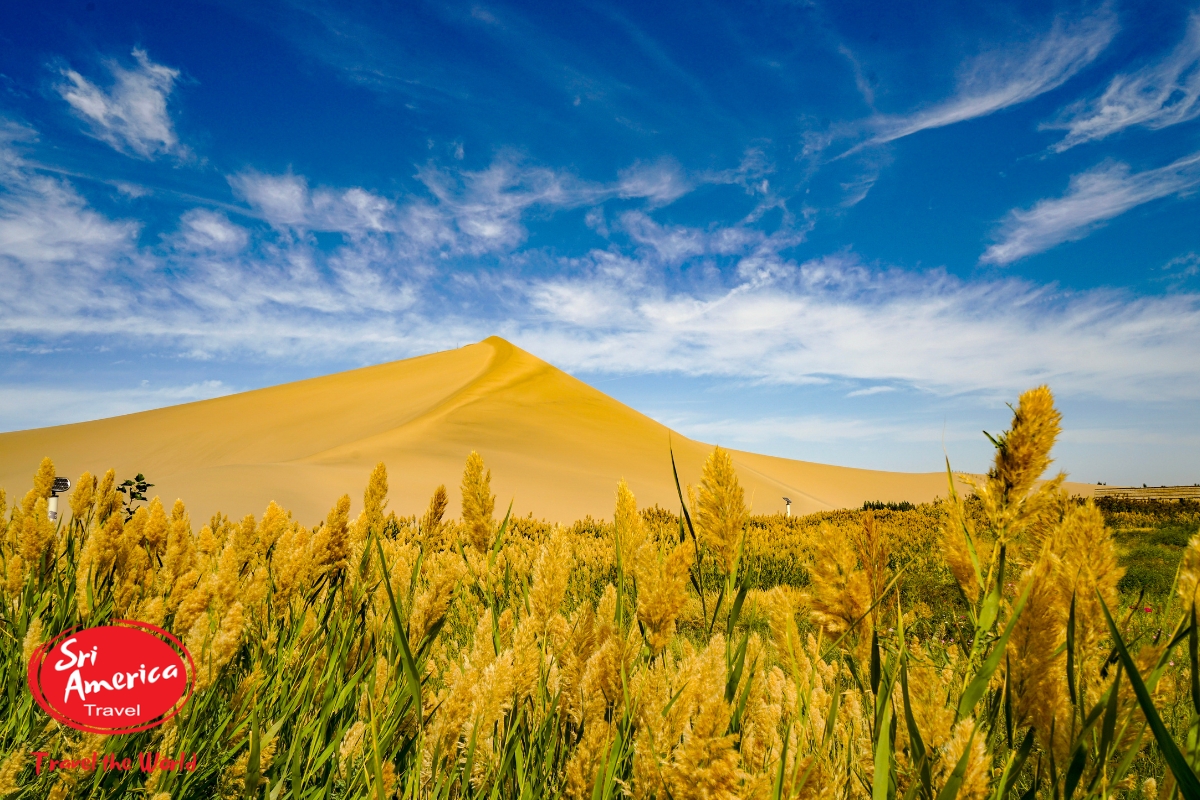
Mingsha Mountain is a dune field on the edge of town. You ride a camel out into the dunes, climb one on foot and slide back down. The sand here genuinely makes a sound, a low drone you can hear across the dunes when conditions are right. Sunset is the time to be up there. At the foot of the dunes lies Crescent Lake, a spring-fed curve of water with a pavilion beside it that has somehow never been buried by the sand. It is a short walk from the camel station and one of the most photographed spots in China.
In the evening the night market is where everyone ends up, with lamb skewers, apricot juice, dried fruit and carpets.
The Mogao Grottoes, a short drive from town, hold the most important Buddhist art in China. Work began here in the fourth century and continued for a thousand years, leaving hundreds of decorated caves filled with murals and painted sculptures. You enter in a small guided group with a torch, and a guide unlocks a set of caves and takes you inside. The paint is astonishingly fresh, and the caves are cool, dark and completely silent. Numbers are capped each day to protect the murals and the caves are rotated, so no two visits are the same. Book well ahead.
Turpan
Turpan sits in a depression below sea level and is one of the hottest places in China, which is exactly what makes it interesting.
The Flaming Mountains run along the northern edge, bare red sandstone gullied into vertical folds that really do look like flames. There is a viewing area with a giant thermometer, and the ground here has recorded some of the highest surface temperatures ever measured anywhere on earth.
That anything grows in this heat at all is down to an ancient network of underground water channels carrying snowmelt from the mountains without letting it evaporate. You go down into one of them, and the drop in temperature as you descend is startling.
Nearby, an ancient city sits on a plateau between two river valleys, and you walk right through the middle of it. What makes it remarkable is that it was not built up but carved downward out of solid earth, with streets and buildings excavated from the ground. Go early or late, because there is no shade at all. Turpan is also grape country, and the vine trellises, raisin-drying houses and local wine are worth an afternoon on their own.
Urumqi
Heavenly Lake sits high in the mountains above the city, a deep glacial lake ringed by spruce forest with snow peaks behind. You take a boat across and walk the lakeside paths, and after days in the desert the change in temperature is very welcome.
Back in the city, the Grand Bazaar is where the journey ends for most people, and it is the best shopping on the route: carpets, dried fruit, spices, nuts, jade, silk and musical instruments, with plenty of room to bargain.
The food across this whole region deserves a mention of its own. Big-plate chicken, hand-pulled noodles, lamb grilled over red willow branches, pilaf, and flatbread baked against the side of a clay oven.
At SATravel.my, we make your journey easier and more enjoyable. We offer China tour packages with experienced local guides, comfortable hotels and smooth travel arrangements. Let us take care of the details, so you can relax and enjoy the beauty of the Silk Road with peace of mind.