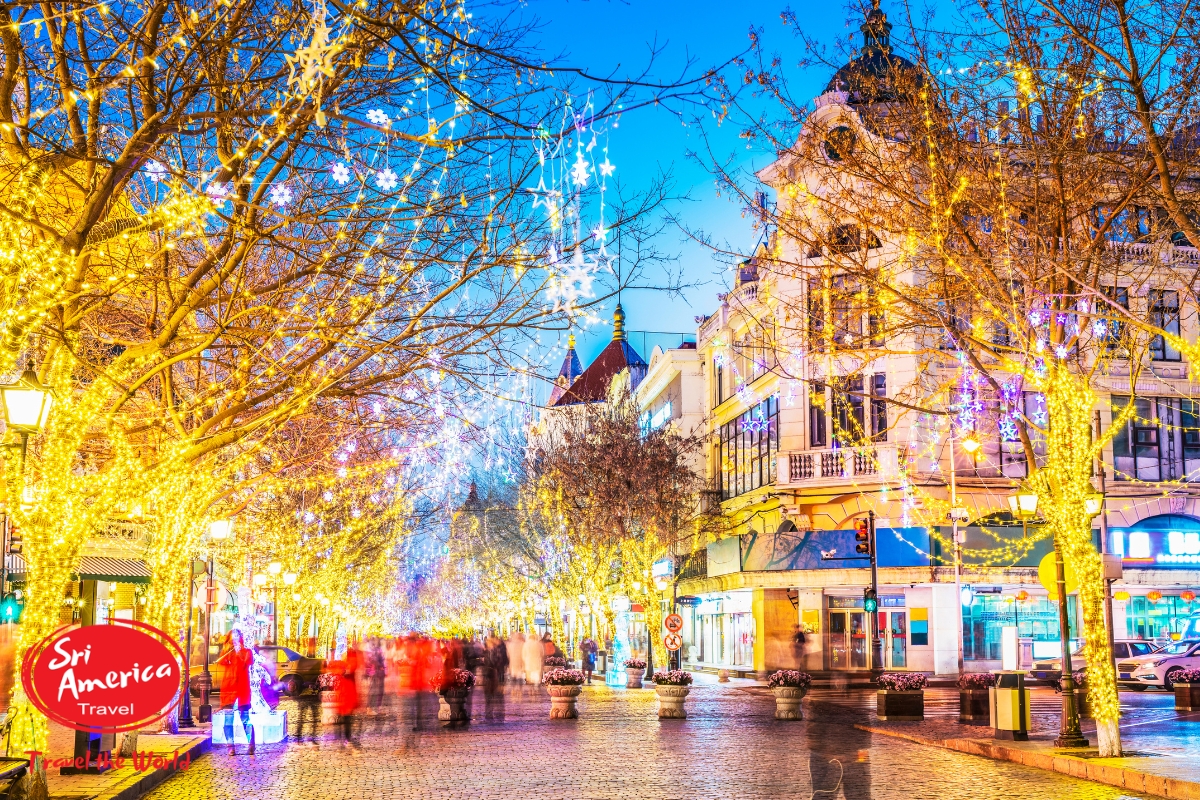
Harbin does not look like the rest of China. It has Russian onion domes, a long cobbled shopping street, and a wide river that shapes the whole city. A few hours away there are forest villages buried under deep snow, a stretch of riverbank where the trees turn white overnight, and an imperial palace with quiet courtyards you can walk through almost alone.
Most Malaysians have never thought about China's Northeast, and that is part of its appeal. It sits far above Beijing, closer to Russia than to Shanghai, and it offers a completely different kind of holiday. A few of the sights below only exist in the coldest months, because they are built from ice and snow. The rest are there all year.
The Ice Cities
Harbin Ice and Snow World is the one you have seen in photographs, and it is far larger than any photograph suggests. Whole palaces, towers and pagodas are cut from river ice and lit from within, so the entire park glows after dark. You walk through streets of ice, climb staircases carved from it, and ride ice slides long enough that you arrive at the bottom breathless and laughing.
Go in the late afternoon. You will see the sculptures in daylight, watch them change colour as the sun drops, and be standing there when the lights come on.
Sun Island is the quieter companion, and it is actually the bigger of the two. Everything here is carved from packed snow rather than ice, so there are no coloured lights and no rides, just an open park filled with enormous white figures of animals and landscapes, some several storeys high. It opens in the mornings, which pairs neatly with an evening at Ice and Snow World.
Russian Harbin
The city grew up around a railway built by Russian engineers, and their architecture is still everywhere.
Saint Sophia Cathedral is the single best photograph in Harbin, a tall Russian church topped with a huge green dome, rising above an open plaza full of pigeons. Inside is a small museum on the city's architecture, worth half an hour.
Central Avenue is where you spend an evening. It is the longest pedestrian street in Asia and the only cobbled street in the city, lined with Baroque and Art Nouveau buildings that are beautifully lit after dark, along with bakeries selling Russian breads, restaurants and souvenir shops. Local habit is to eat ice cream outdoors no matter the temperature, and it is worth doing once.
Down by the water, Stalin Park runs along the riverbank and changes completely with the seasons. In winter it becomes an extension of the ice festival, with sculptors working along the river and ice activities out on the frozen water. In summer it is the busiest place in the city, with people swimming in the river and the promenade full into the evening.
A little outside town, Volga Manor is a large estate of Russian-style buildings set across open parkland, with onion-domed churches, a photographic salon and a traditional Russian bathhouse. Under snow it feels genuinely Russian, and in warmer months it is green and easy to wander.
Snow Town and the Rime Ice
China Snow Town is the most atmospheric place in the Northeast. Snow piles up on the wooden rooftops in thick rounded caps, and villagers hang red lanterns beneath them. At night, lit up, it looks like a film set.
There is more to do here than photograph it. You can take a horse-drawn sled through the village, climb a boardwalk up the hillside for the view down over the rooftops, and send a postcard home from what locals call the Fairy Tale Post Office. That postmark is the souvenir people actually keep.
Nearby in Jilin, a warm-water river refuses to freeze, so mist rises off it and settles onto the trees along the bank, coating every branch in white crystal. Locals call it rime ice. You walk a stretch of riverbank in the early morning while it lasts, because once the sun climbs it falls from the trees. Early is not optional here.
Mukden Palace
Most people do not realise there are two imperial palaces in China. The famous one is in Beijing. This one, in Shenyang, came first, and it is a UNESCO World Heritage Site.
What makes it a pleasure is how few visitors it gets. You can stand in a courtyard and hear nothing at all, which is not something anyone says about the Forbidden City.
When to Go
Harbin has one of the widest temperature ranges in China, so the season you choose changes the trip completely.
December to February is when the ice sculptures and the rime ice appear. It is properly cold, and you will want serious winter clothing. March to May warms quickly, ending in comfortable days and cool evenings. June to August surprises people, because summer here is far milder than Beijing or Guangzhou, which is exactly why Chinese travellers come north to escape the heat. September and October bring the nicest weather of the year, dry and clear with the forests turning colour.
For a winter trip, layer properly. Thermals against the skin, fleece or down in the middle, and a windproof hooded jacket on top. Pay most attention to hands, ears and feet, and bring adhesive heat packs. Many visitors simply buy their heavy coat after arriving in Harbin, where it is cheaper and better suited to the climate.
At SATravel.my, we make your journey easier and more enjoyable. We offer China tour packages with experienced local guides, comfortable hotels and smooth travel arrangements. Let us take care of the details, so you can relax and enjoy the beauty of Harbin and the Northeast with peace of mind.